
Instant Article 4 checks, planning permission likelihood and HMO rules for any Birmingham postcode – in 30 seconds.
Saving on feasibility cost
Time taken to generate report
The most accurate and up-to-date planning data available in the UK.






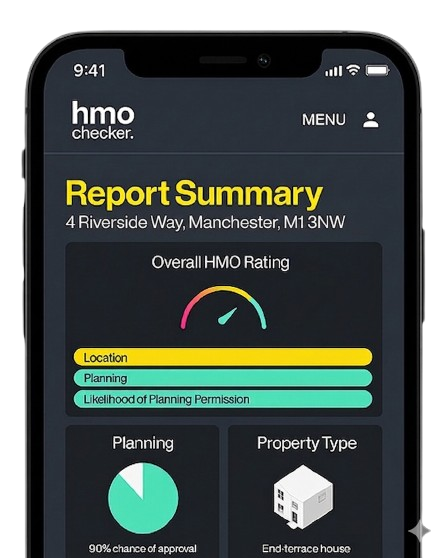
Birmingham’s HMO rules are more complex than most cities. HMO Checker cuts through them – checking Article 4 status, planning likelihood, HMO density, licensing and projected yields for any Birmingham postcode instantly.
Check planning application history, approval rates and Article 4 implications for any Birmingham or West Midlands postcode.
Explore Planning Analysis
Access projected room rents, gross and net yield calculations and commercial valuation uplift based on live Birmingham market data across all West Midlands postcodes.
Explore HMO Yield & ROI
Our Maps feature lets you see where HMO reports have been run across Birmingham. Each pin shows whether the report result was Great, Good, or Poor.
Explore HMO Maps
HMO Checker evaluates density within a 100-metre radius of your property. In Birmingham, density is the primary factor the council applies under Policy H11.
HMO Checker scans Rightmove listings automatically, saving hours of manual research across Birmingham's most active HMO postcodes.
Explore HMO Sourcing
Verify whether your Birmingham property falls within the city-wide Article 4 Direction. Unlike most cities, Birmingham's direction covers every postcode with no exceptions.
Explore Article 4 Checker
Birmingham’s HMO market delivers strong yields, but it’s the most regulated in England outside London.
Birmingham City Council’s city-wide Article 4 Direction means every HMO conversion requires full planning permission, and the council’s HMO SPD means density on your specific street determines whether that permission is likely to be granted. On top of that, Birmingham introduced a citywide additional licensing scheme in 2023 – the only major English city to have done so – extending licensing to smaller three and four person HMOs across the entire city.
The difference between a deal that works and one that doesn’t often comes down to a single postcode. HMO Checker checks Article 4 status, planning likelihood, HMO density and licensing requirements instantly, so you know your position before you make an offer.
Run any Birmingham postcode through HMO Checker and get your full Article 4 status, planning likelihood, density and financial report in seconds.


Property Developer
Property Developer
Avenue 1 Holmes
Landlord, London
Try our suite of free tools for investors and landlord in Birmingham.
Quickly calculate the value of any HMO deal with our free HMO valuation calculator.
Appraisal Calculator >
Calculate a tailored cost estimate based on typical benchmarks used across the industry.
Conversion Calculator >
Our free Article 4 Checker will verify whether your property falls within an Article 4 directions area in the UK.
Article 4 Checker >
Yes. HMO Checker uses live planning and licensing data from Birmingham City Council and all surrounding West Midlands authorities including Sandwell, Solihull, Wolverhampton, Walsall, Dudley and Coventry.
Yes. Birmingham City Council's city-wide Article 4 Direction came into force on 8 June 2020 and covers every postcode in the city without exception.
It means planning permission is required to convert any standard dwelling to a small HMO anywhere in Birmingham. Planning applications are assessed against the council's HMO Supplementary Planning Document, with local density as the primary factor in whether permission is granted.
B29 (Selly Oak and Bournbrook) consistently delivers the strongest yields at around 7.5%, driven by high student demand from the University of Birmingham.
B23 (Erdington) offers lower entry costs with yields of 5.4% to 7% and a professional tenant profile that keeps demand steady year-round.
Digbeth is emerging as Birmingham's strongest professional HMO market, driven by major regeneration investment around the HS2 Curzon Street terminal.
HMO density is the concentration of HMOs within a given area.
In Birmingham it is the primary factor the council applies when assessing planning applications under its HMO SPD - where concentration is already high on a specific street, further conversions are likely to be refused.
This is why a density check at postcode level, before you make an offer, is one of the most important steps in Birmingham deal analysis. HMO Checker runs this check automatically alongside Article 4 verification.
Yes - and Birmingham's licensing requirements go further than most cities. Mandatory HMO licensing applies to any property with five or more occupants from two or more households.
Birmingham City Council's citywide Additional Licensing scheme, introduced in June 2023, also extends licensing to smaller three and four person HMOs across the entire city. Birmingham is the only major English city to operate additional licensing on this scale, so always factor licence fees and application timelines into your deal analysis from day one.
Yes, in almost all cases. Birmingham's city-wide Article 4 Direction means permitted development rights for C3-to-C4 conversions have been removed across the entire city.
You will need full planning permission for any new HMO conversion, and the application will be assessed against Birmingham City Council's HMO SPD.
The exception is properties where a lawful HMO use was established before the Article 4 Direction came into force - these may benefit from a Certificate of Lawful Existing Use or Development (CLEUD).
HMO Checker covers the whole of the UK. Here are some of the key areas HMO investors may be interested in:
One of the UK's strongest HMO markets. Borough-wide Article 4 across the city makes postcode-level data essential.
Manchester HMOs >
Complex HMO rules, high density and intense competition make data-driven analysis critical before committing to any London deal.
London HMO Investment >
Strong student demand from the University of Southampton and a growing professional population, with Article 4 restrictions across key postcodes.
Strong rental demand from students and professionals, but Edinburgh's HMO licensing is tightly controlled in the UK.
Growing professional demand and competitive yields, with Article 4 now affecting key investment areas across the city.
Scotland's largest HMO market operates under a distinct licensing regime, stricter than most of England.