

In the world of HMO sourcing, most investors live and die by the local housing market’s demand. They find a property with the perfect layout, see that it sits in a popular rental area, and assume securing planning permission for a Class C3 to Class C4 conversion is a foregone conclusion.
However, local authorities are becoming increasingly analytical. Councils no longer guess or approximate neighbourhood saturation; instead, they rely on precise mapping data to run what is known as an HMO Density Test.
If a property fails this test by even a single house, the application faces immediate refusal. Understanding exactly how councils draw these boundaries is essential to protect your capital and ensure your next HMO deal has a viable path to approval.
What is the 50m or 100m HMO Density Rule?
An HMO density radius is a calculation used by local planning authorities to assess the concentration of shared housing surrounding a prospective HMO. Depending on the local council’s guidelines, this line is typically set to a radius of either 50 meters or 100 meters.
To conduct this assessment, a planning officer puts your property’s coordinates into Geographic Information Systems (GIS) software. The system draws a perfect mathematical circle using the center point of your property as the axis.
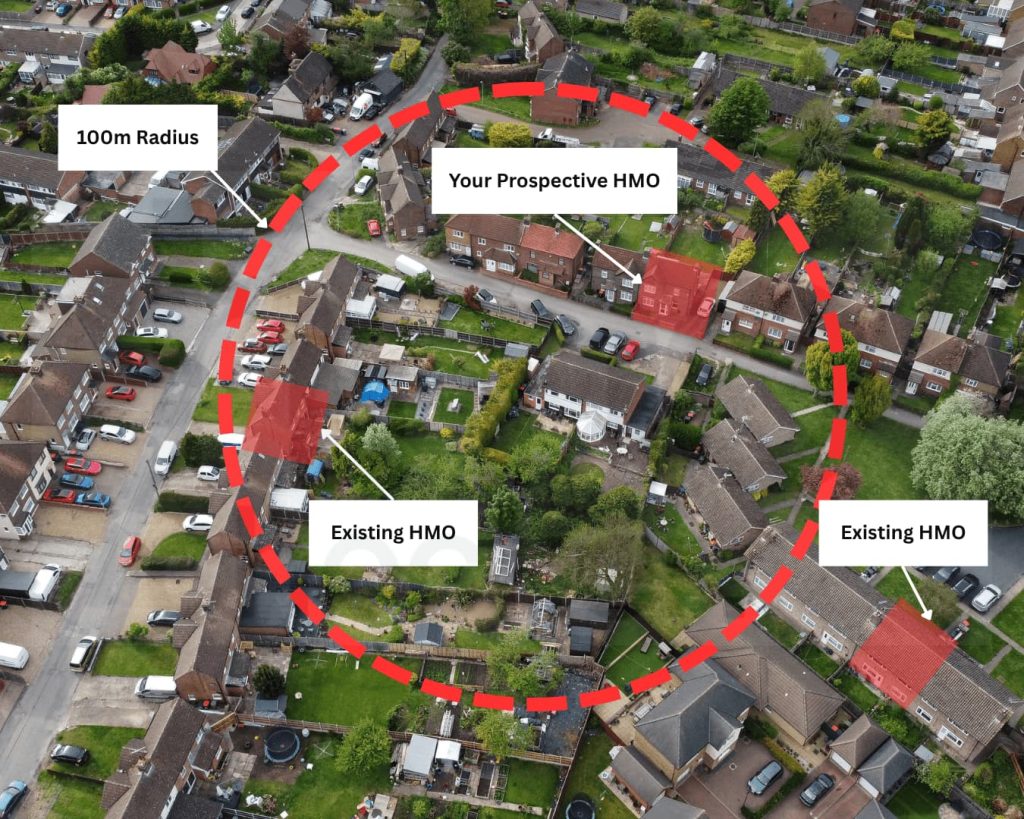
The software automatically counts every single residential dwelling that falls inside or intersects that circle. It then compares that number against the number of officially recognised HMOs in the same boundary to generate a percentage score. If that score breaches the council’s local saturation limit, frequently capped between 10% and 20%, the property is deemed to cause “over-concentration” and the application is rejected.
HMO Density vs HMO Sandwiching
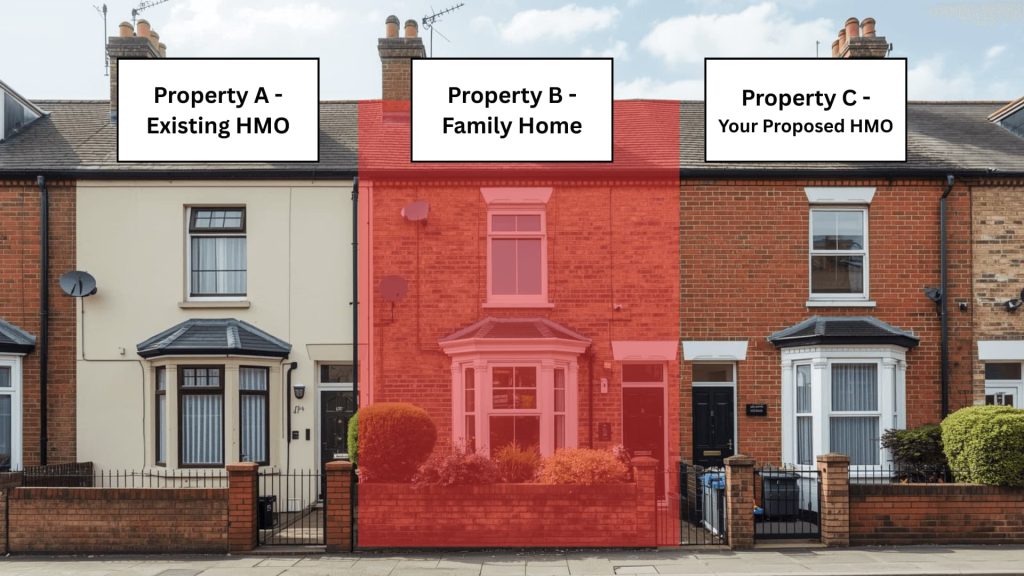
Both HMO density and HMO sandwiching are planning policies, but they are both enforced differently and have different purposes.
HMO Density is a measurement of the wider neighborhood to see if the community is balanced or if it has reached a tipping point of shared housing. Councils use policies to set a threshold, usually 10% within a 50 or 100m radius, to prevent any one area from becoming too densely populated with HMOs.
HMO sandwiching looks only at your immediate neighbours. Councils argue that while 10% density is fine for a neighbourhood, having shared houses on both sides of a family home can cause problems for those specific residents.
HMO Density Radius vs Continuous Frontage
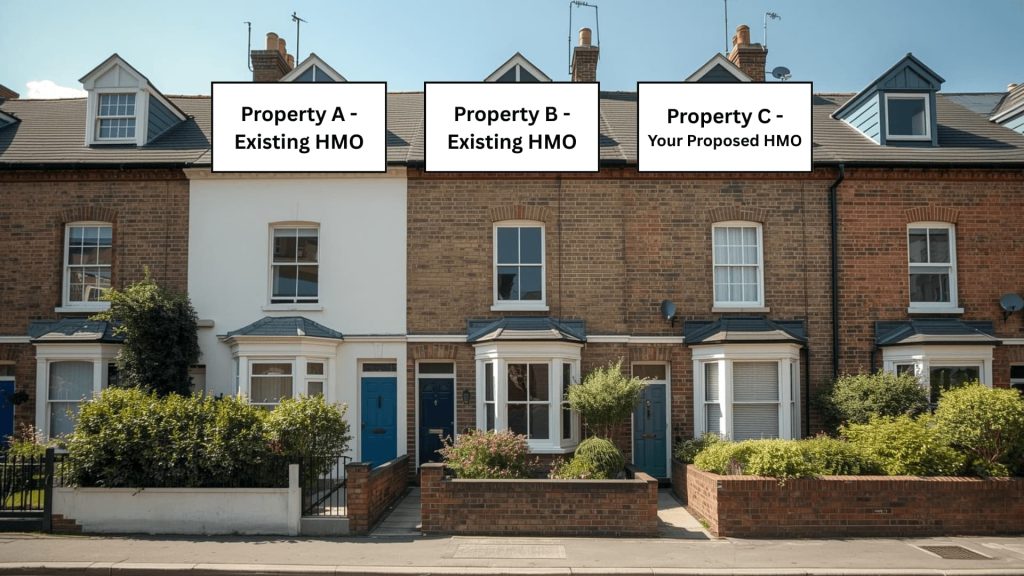
As with HMO sandwiching, a continuous linear frontage is another type of policy a planning authority might look at to determine HMO density outside of the standard 50m or 100m radius rule.
For example, some urban local authorities may bypass the circular radius entirely. Instead, they look only at the linear row of buildings on your immediate side of the street. They might stipulate that no more than 1 in 5 consecutive houses on that specific street frontage can be a shared home, for example. It’s important to therefore understand the HMO density restrictions of your local council.
Examples of Council HMO Density Rules
Even if you fully understand how the HMO density rule works, you can still easily get caught out if you apply the wrong council’s logic to your target property. Because local authorities across England operate independently, there is no single, national standard for measuring housing saturation.
While one council might look at a tight 50-meter micro-pocket, the borough next door might run its calculations across a much wider 100-meter area. To help you better understand how different council rules can vary across the UK regarding HMO density, the below table shows 10 of the strictest local planning authorities in the UK.
| Council / Authority | Density Limit Enforced | Official Policy | Additional Considerations |
| Portsmouth City Council | Maximum 10% within a 50m radius | Portsmouth HMO SPD | Because the area is small, it only takes one or two neighboring HMOs to push you over the 10% limit. |
| Bristol City Council | Maximum 10% within a 100m radius | Bristol HMO SPD | They look at a wider 100m circle. On top of the percentage check, they will also reject you if your project traps a family house directly between two existing HMOs. |
| Birmingham City Council | Maximum 10% within a 100m radius | Birmingham HMO SPD | Governed under Policy DM11. If the 100m circle lines cut through even a tiny corner of a neighbor’s boundary, that property is fully counted in the math. |
| Coventry City Council | Maximum 10% within a 100m radius | Coventry HMO SPD | Alongside the circular test, they look at the immediate street layout to stop investors from building long, continuous blocks of shared houses in a single row. |
| Oxford City Council | Maximum 20% within a 100m radius | Oxford HMO SPD | While a 20% allowance sounds generous, Oxford tracks data very closely. If an HMO is left empty or rented to a standard family even briefly, its legal status can be permanently lost. |
| Southampton City Council | Maximum 10% to 20% within a 50m radius | Southampton HMO SPD | In student heavy areas (like Portswood), they cap density at a strict 10%. In parts of the city center, they allow up to 20%. |
| Brighton & Hove City Council | Maximum 10% within a 50m radius | Brighton HMO SPD | They also enforce a neighbour rule meaning you cannot have more than two HMOs sitting immediately next to each other. |
| Manchester City Council | Variable limits (depends on the specific ward layout) | Manchester Local Plan | Instead of a single flat rule, they change their limits based on the area. They heavily restrict new conversions in student hubs like South Manchester. |
| Liverpool City Council | Maximum 10% within a 50m radius | Liverpool SPD | They enforce a strict 50m check across the city to stop small family homes from being converted without explicit permission. |
| Newcastle City Council | Variable limits based on local walking distances | Newcastle HMO SPD | Rather than using a perfect computer-drawn circle, they often look at actual walking distances down the street to see if a block feels overcrowded. |
HMO Density Legislation
The restriction of HMO density isn’t an arbitrary choice by local planning departments; it is anchored in national policy. The foundational mandate comes from the National Planning Policy Framework (NPPF) Chapter 5, which instructs local authorities to foster “inclusive, mixed, and balanced communities.”
To implement this on a local level, councils use their statutory powers under Section 70 of the Town and Country Planning Act 1990 to establish strict density ceilings within their overarching Local Plans.
The precise mechanics, such as defining whether a 50m or 100m radius is used, are published in local Supplementary Planning Documents (SPDs). Because these SPDs carry heavy statutory weight, planning committees treat these radius caps as absolute legal boundaries rather than flexible suggestions.
How to Check HMO Density Easily
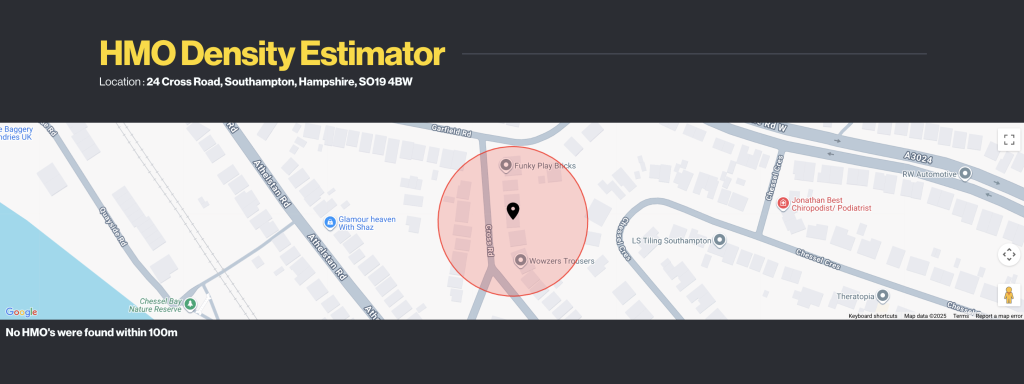
Submitting an application without a thorough audit is a significant financial risk, so checking HMO density is essential to avoid a planning refusal. Traditionally, auditing a street required hours of manual searching through council planning portals and licensing registers. However, HMO Checker allows you to audit any property so long as you have the full address or Rightmove URL.
The HMO Checker Density Tool was built to eliminate guesswork by simulating a professional GIS radius assessment. Once you run a report on a property, you can use the Density Tool to set a specific radius (usually 50m or 100m) around your property.
Instead of requiring investors to manually plot distances on digital maps, the platform pulls real-time data from disparate planning applications, licensing records, and council registers into a single dashboard.
Final Thoughts
The 50m and 100m radius rules are non-negotiable boundaries in the modern HMO property landscape. In an era where Article 4 directions are becoming standard policy, your success as a developer relies on your ability to evaluate a street layout using the exact same data parameters as a local planning officer.
By auditing your target street before entering negotiations, you can spot high-saturation traps early, walk away from unapprovable deals, and dedicate your capital exclusively to properties with a clear, verified route to planning success.


