

In the world of HMO sourcing, most investors live and die by the “10% Density Rule.” They check a 50m radius, see that the concentration is low, and assume planning permission for a C3 to C4 conversion is a formality.
However, in 2026, local authorities are becoming increasingly surgical with their refusals. Even if an area is well below its saturation threshold, a single “micro-concentration” issue can lead to an immediate rejection. This is known in the planning world as The Sandwiching Rule.
Understanding this rule is the difference between a successful conversion and a costly planning battle. This guide breaks down why councils use this “amenity-first” approach and how you can spot a “sandwich trap” before you commit to a deal.
What is the HMO Sandwiching Rule?
In the simplest terms, HMO sandwiching is when a family home is “trapped” between two HMOs on the same side of the road.
To see if a property is “sandwiched,” planning officers look at a row of three houses in a line. If the two houses on the outside are HMOs, the house in the middle is considered “sandwiched.” If you apply to change a house into an HMO, and your new HMO would result in a standard family home (C3) having an HMO on both sides, your application will likely be refused.
The “A-B-A” Pattern
Think of it as a pattern on a single side of the street:
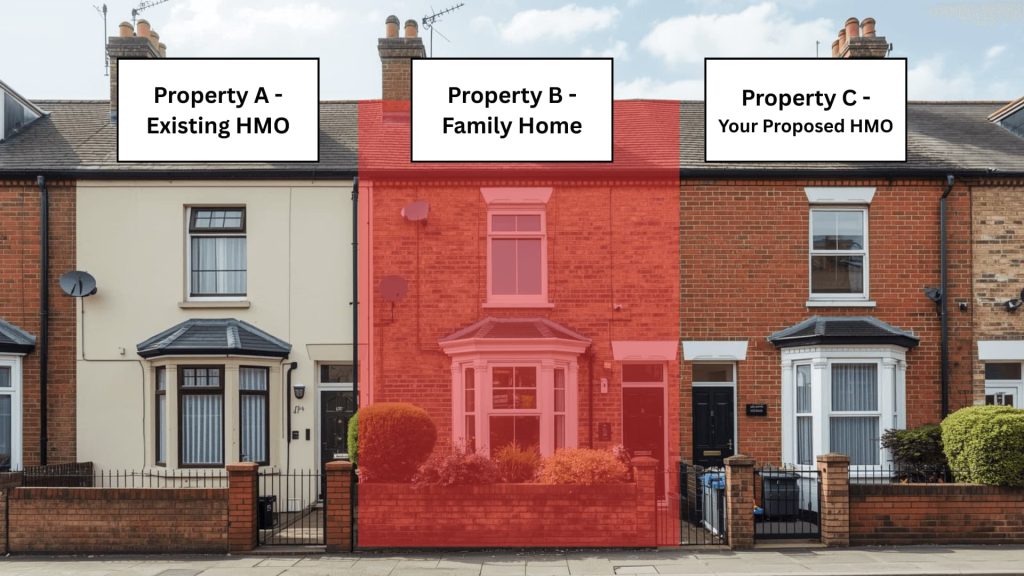
If you convert Property C, then Property B becomes the “filling” in an HMO sandwich. Councils block this because they believe living with shared houses on both sides creates an “unacceptable level of noise and disturbance” for a single family.
It’s worth noting that for a sandwich to exist, the house in the middle must be a Class C3 residential dwelling (a standard family home). If the house in the middle is already a shop, an office, or another HMO, the sandwiching rule usually doesn’t apply.
When does HMO Sandwiching matter?
If you are submitting a planning application, such as a C3 to C4 application in an Article 4 area, or a Sui Generis planning application, HMO sandwiching will be one of the factors that the council assesses when it comes to accepting or refusing your application.
HMO Density vs HMO Sandwiching
Both HMO density and HMO sandwiching are planning policies, but they are both enforced differently and have different purposes. Many investors make the mistake of focusing entirely on density while completely ignoring sandwiching. To a planning officer, these are two separate “gates” you must pass to get an approval.
HMO Density is a quantitative measurement of the wider neighborhood to see if the community is “balanced” or if it has reached a tipping point of shared housing. To implement this, councils use policies to set a threshold, usually 10% within a 50 or 100m radius, to prevent any one area from becoming too densely populated with HMOs.
However, while density looks at the whole neighborhood, sandwiching looks only at your immediate neighbors. The core legal argument for sandwiching is “Amenity Harm.” Councils argue that while 10% density is fine for a neighborhood, having shared houses on both sides of a family home causes “unacceptable noise and disturbance” to those specific residents.
How HMO Density vs Sandwiching is Regulated
Density is primarily governed by theNational Planning Policy Framework (NPPF), specifically Chapter 5: Delivering a sufficient supply of homes. The NPPF requires local authorities to plan for a “mix of housing” to meet the needs of different groups.
To implement this, councils use Section 70 of the Town and Country Planning Act 1990 to create local policies (often labeled “Policy H” or “Policy CP” in their Local Plan).
Sandwiching is rarely written into the main Local Plan. Instead, it lives in Supplementary Planning Documents (SPD). Under Section 38(6) of the Planning and Compulsory Purchase Act 2004, planning decisions must be made in accordance with the “Development Plan” (which includes these SPDs).
The “Three-in-a-Row” Rule: Preventing HMO Clusters
Even if you aren’t sandwiching a family home, you might still face a refusal if your property becomes part of an HMO cluster. Many councils also have a secondary rule often found right next to sandwiching in their policy books: The Three-in-a-Row Rule.
This rule states that planning permission will be refused if it would result in three or more HMOs being located immediately adjacent to each other in a continuous frontage. For example, if houses 2 and 3 are already HMOs, and you want to convert house 4, the council may refuse it because it creates a solid block of three HMOs on that side of the street.
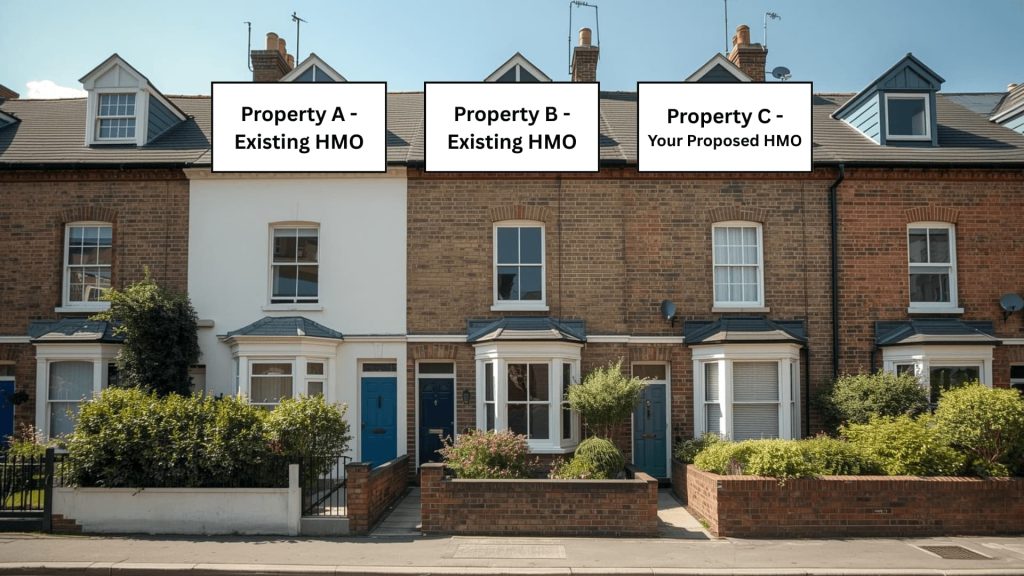
The goal is to prevent the “tipping point” where a section of a street loses its residential feel entirely. Councils believe that while one or two HMOs can integrate into a row of houses, three in a row creates a “dominant” presence that changes the character of the street.
Examples of some councils that implement this in their SPD include Brighton & Hove, which implement the three-in-a-row rule, and Bristol implement a similar no sandwiching / no clustering rule. It’s important to check your local council’s SPD when considering your own planning application, as the rules will differ from council to council, and some areas won’t have this particular rule enforced.
How to Check HMO Density & Sandwiching
Submitting an application without a thorough audit is a significant financial risk, so conducting thorough planning analysis and checking HMO density and sandwiching is essential to avoid a planning refusal. By auditing your neighbors before you buy, you can identify “deal-breaker” issues like sandwiching or clustering that lead to automatic rejections, allowing you to save your capital for properties with a genuine path to approval.
Traditionally, auditing a street required hours of manual searching through council planning portals and licensing registers. HMO Checker is an HMO sourcing tool designed to simplify this by aggregating all these disparate data sources into a single, visual dashboard.
How to Check HMO Density
HMO Checker allows you to audit any property so long as you have the full address or Rightmove URL. Once you run a report on a property, you can use the Density Tool to set a specific radius (usually 50m or 100m) around your property.
HMO Checker instantly calculates the number of HMOs in that circle, as well as percentage density.

How to Check HMO Sandwiching
Once the area density is cleared, you need to check for Sandwiching and Three-in-a-Row risks on your specific street frontage.
HMO Checker will show you the closest HMOs in a list with the exact addresses of every registered HMO nearby. Using the address list, you can see if there are any HMOs in very close proximity to your prospective HMO, checking the street address and house number.
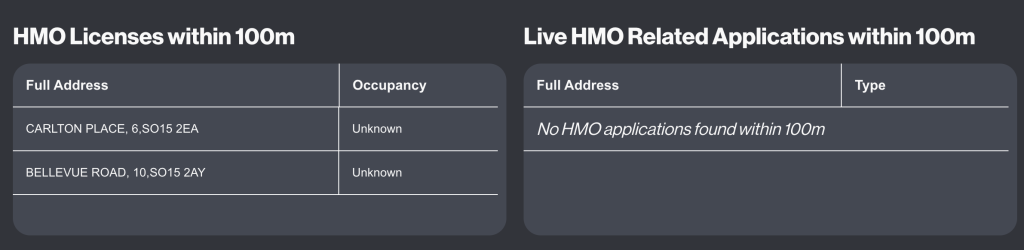
If you notice that there is a registered HMO adjacent to your searched address, it’s worth speaking to an expert or considering that there could be a sandwiching or three-in-a-row risk if you move forward with that application.
Final Thoughts
The “Sandwiching Rule” and the “10% Density Rule” are two of the most significant hurdles for HMO investors in 2026. While they may feel like invisible traps, they are entirely predictable if you have the right data.
In an Article 4 area, your success depends on your ability to see the street exactly how a planning officer sees it. By performing a quick audit before you commit to a purchase, you can steer clear of “unapprovable” properties and focus your time and money on deals with a high probability of success.


