

A commercial HMO valuation is a vital tool for investors aiming to maximise returns from Houses in Multiple Occupation. Unlike traditional residential valuations, a commercial HMO valuation treats the property as an income-generating asset, focusing on rental income, occupancy levels, property condition, compliance with licensing and building regulations, and local market demand. Larger HMOs, typically six or more bedrooms or seven or more occupants, are most likely to receive a commercial valuation, especially when they are professionally designed, fully compliant, and efficiently managed.
Location is a key factor in any commercial HMO valuation. Properties near universities, hospitals, and major employment hubs generally achieve higher valuations due to strong tenant demand. High-quality layouts, en-suite bathrooms, and well-maintained communal spaces further enhance rental potential and reduce void periods. By combining accurate financial data, proof of compliance, and insights from tools like HMO Checker, investors can confidently navigate the commercial HMO valuation process, secure appropriate financing, and scale their HMO portfolios successfully.
What is a Commercial HMO Valuation?
A commercial HMO valuation is a professional assessment that determines the investment value of an HMO property. This is different from a standard residential (or bricks-and-mortar) valuation because it factors in the income generated by the property. Essentially, the property is treated as a business rather than a family home.
In practice, a commercial HMO valuation considers:
- The rental income achievable from the property.
- Operating costs and outgoings associated with running the HMO.
- The local market and demand for HMOs.
- Compliance with licensing, fire, and building regulations.
This type of valuation is particularly relevant when seeking HMO mortgages, as lenders often need a clear understanding of the investment value and associated risks.
When is an HMO Commercial Valuation Used?
A commercial valuation for HMOs differs significantly from a standard bricks-and-mortar valuation. While bricks-and-mortar valuations treat a property as a conventional residential home, focused primarily on the resale value of the property in the local housing market, a commercial valuation considers the property as an income-generating business. This means that the HMO’s rental income, operating costs, and overall yield play a central role in determining the valuation.
For example, a four-bedroom house that could be easily sold as a family home is typically valued on a bricks-and-mortar basis. The surveyor looks at comparable sales in the area and the market price for similar homes. In contrast, a large HMO with five or more lettable rooms is likely to be valued on a commercial basis. Here, the property’s ability to generate rental income takes precedence, and factors such as tenant demand, occupancy rates, and HMO licensing compliance all influence the valuation.

Are Commercial HMO Valuations Required for HMO Mortgages?
Not all HMO mortgages require a commercial valuation, but for larger or higher-yield HMOs, they are often essential. Understanding when a commercial valuation is needed can help investors plan their financing strategy effectively.
Circumstances Where a Commercial Valuation Might Be Used
- The property is a large HMO with 5+ bedrooms designed for multiple tenants.
- The property is located in a high-demand area for HMOs, such as near universities, hospitals, or large employment hubs.
- The property is in an Article 4 area, where permitted development rights for HMO conversions are restricted, often increasing the value of licensed HMOs.
- The property is purpose-built or adapted for HMO use, with layouts, en-suites, and shared facilities optimized for multiple tenants.
- The investor is applying for an HMO-specific mortgage, and the lender allows a commercial valuation to determine lending limits.
Typical Thresholds for Commercial Valuations
Lenders usually consider a property’s size and income potential when deciding whether a commercial valuation is necessary:
- Smaller HMOs (C4, 3–6 tenants): Often assessed on a standard residential “bricks-and-mortar” basis. Lenders focus on comparable property values in the local market.
- Larger HMOs (Sui Generis, 7+ tenants): Almost always require a commercial valuation. These HMOs are treated as income-generating businesses, and lenders need an accurate picture of the projected net income, compliance, and management to determine lending capacity.
In some cases, smaller HMOs in low-risk areas may not need a commercial valuation if:
- The property is well below the lender’s size or income threshold
- The rental income is relatively modest
- The HMO is fully compliant, professionally managed, and comparable to similar residential properties
Even in these cases, obtaining a commercial valuation can still benefit investors by demonstrating income potential and strengthening mortgage applications.
While smaller HMOs may not always require a commercial valuation, most Sui Generis properties and high-yield HMOs do. Obtaining one ensures lenders have confidence in the property as an income-generating asset and can significantly improve your borrowing potential.
How is a Commercial HMO Valuation Calculated?
A commercial valuation focuses on rental income and the potential return on investment. Surveyors typically use the following approach:
- Determine Market Rent: Assess the achievable rent for each room or unit based on local demand and comparable HMOs.
- Deduct Operating Costs: Include ongoing expenses like maintenance, insurance, management fees, and utilities where applicable.
- Apply a Yield: The net rental income is divided by a yield percentage reflective of local market conditions to determine the commercial value.
Example Calculation
| HMO Type | Net Annual Rent | Typical Yield | Commercial Valuation |
| 7-bed HMO | £79,800 | 7% | £1,140,000 |
Net Annual Rent ÷ Yield = Commercial Valuation
This is a simplified example. In reality, yields and rental assumptions may vary based on location, property quality, and HMO demand.

Key Factors Surveyors Consider in a Commercial HMO Valuation
Rental Income Potential
Surveyors often start by evaluating how much rental income the property can realistically generate. They consider the number of lettable rooms, typical occupancy levels, and the local rental market. Properties located near universities, hospitals, or major employment hubs tend to command higher rents. Features such as en-suite bathrooms, larger bedrooms, and modern kitchens can further boost rental value and make the property more attractive to tenants.
Occupancy
Surveyors typically prefer HMOs with 6+ occupants, with Sui Generis HMOs (7+ bedrooms and tenants) being the most straightforward for commercial valuation. A high-end, well-managed 6-bedroom HMO can also qualify, particularly if one room is doubled to create 7 occupants. Sui Generis HMOs are favoured because valuers are confident they are unlikely to revert to family homes and compliance standards are generally higher.
Property Condition
The overall state of the HMO plays a major role in valuation. Well-maintained properties with quality finishes, functional communal areas, and up-to-date HMO kitchens and bathrooms are more appealing to tenants and surveyors alike. Compliance with HMO licensing, building regulations, and safety standards also contributes to a higher valuation, as these factors reduce the risk of enforcement issues and potential costs.
HMO Management
The property’s management approach matters. Professional management can provide valuer confidence in rent collection, tenant care, and operational reliability, all of which support a higher valuation.
Location and Local Market Factors
The neighbourhood and surrounding amenities significantly influence a property’s value. Surveyors look at proximity to transport links, shops, and leisure facilities, as well as the density of HMOs in the area. Established HMO communities generally show strong rental demand, though local restrictions such as Article 4 directions may apply. Recent sales and rental data for comparable HMOs are also reviewed to benchmark the property’s market value.
Compliance and Licensing
Ensuring the property meets all legal requirements is critical. Surveyors verify that the HMO licence is in place and that the property complies with fire safety regulations, building codes, and minimum HMO room and facility standards. Properties that are fully compliant are viewed as lower risk, which can positively affect the valuation.
Operating Costs and Net Income
Surveyors also consider the ongoing costs associated with running the HMO. This includes routine maintenance, repairs, management fees, and any utilities or communal bills included in rent. Insurance premiums, council tax obligations, and other recurring expenses are factored in to determine the property’s net income, which directly influences its commercial valuation.
Yield Assessment
Finally, the surveyor applies a yield to the net rental income to calculate the commercial valuation. Local yield expectations are used to reflect market conditions, demand, and HMO density. Properties in high-demand areas may have lower yields, which increases the valuation, while higher perceived risk or weaker demand typically results in higher yields and a lower valuation.
Picking a Lender
Choosing the right lender can make or break a commercial valuation. Some lenders allow investors to select their preferred valuer, and it’s crucial to work with someone experienced in HMO valuations.
HMO Brokers
Specialist HMO brokers can provide valuable guidance on lenders, products, and valuers, especially in local markets. They help ensure the property and investor are positioned to achieve the best commercial valuation.
How HMO Checker Supports Commercial HMO Valuations
HMO Checker streamlines the process of sourcing and analysing HMO properties with commercial valuation potential. By combining market data, local regulations, and property-specific metrics, HMO Checker allows investors to assess whether a property is likely to achieve a strong commercial valuation before purchase.
Key Features That Support Commercial Valuations
Rental Income Estimation
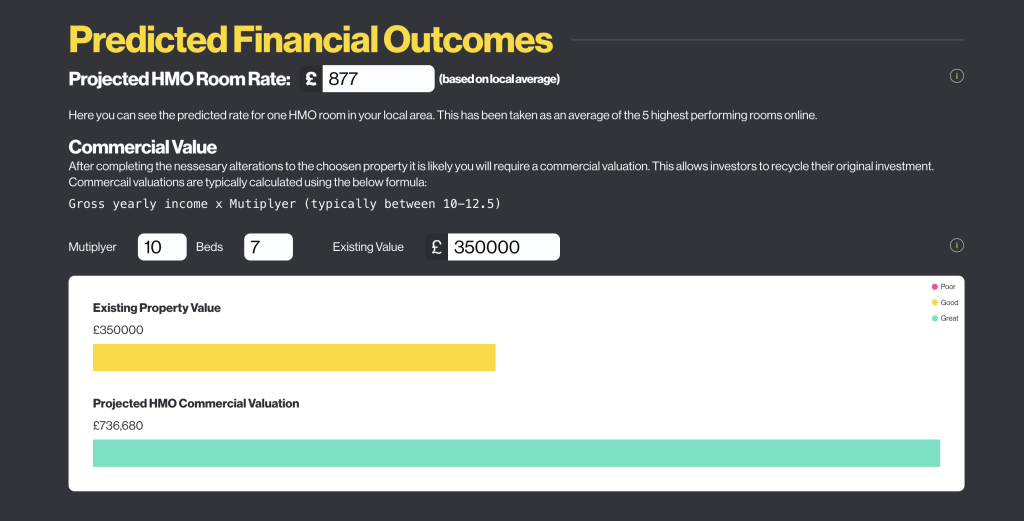
HMO Checker calculates projected rents based on property size, number of rooms, local market demand, and comparable HMOs. This helps investors forecast net income, a core component of a commercial valuation.
Local Demand
The platform provides insights into local HMO demand and HMO density to better understand local demand and competition for HMOs.
Property Suitability Assessment
By analysing property layouts, room sizes, and potential for en-suites or additional bathrooms, HMO Checker helps investors identify HMOs that are likely to be valued as commercial properties rather than bricks-and-mortar.

Article 4 and Planning Data
Investors can quickly identify whether a property sits in an Article 4 area, which often affects HMO demand and the feasibility of a commercial valuation.
How HMO Checker Helps: To Summarise
| Feature | How It Helps Commercial Valuation |
| Predicted Financial Outcomes | Provides net income figures to feed into valuation calculations (Net Annual Rent ÷ Yield). |
| HMO Property Demand | Confirms tenant demand, which supports higher rental yields. |
| Property Layout Analysis | Highlights properties suited for full HMO use (e.g., 5+ beds, en-suites, sufficient bathrooms) that are more likely to achieve commercial valuation. |
| Planning Overview | Helps investors identify properties in restricted areas where HMOs are more valuable as income-generating investments. |
By integrating all these factors, HMO Checker not only helps investors identify high-potential HMOs, but also provides the necessary data to support a strong commercial valuation when approaching lenders. This reduces guesswork, saves time, and increases confidence in investment decisions.
Key Takeaways: Commercial HMO Valuations
Commercial HMO valuations treat properties as income-generating assets rather than conventional homes, with rental income, occupancy, and compliance forming the core of the assessment. Larger HMOs, typically 6+ bedrooms or 7+ occupants, are more likely to be valued commercially, especially if they are well-designed, professionally managed, and compliant with planning, building regulations, and mandatory or additional licensing requirements. Properties with high-quality layouts, en-suite bathrooms, and ample communal spaces tend to command higher rents and reduce void periods, boosting valuation.
Location is a major factor, with HMOs near universities, hospitals, or employment hubs generally achieving stronger valuations. Lenders often rely on commercial valuations to determine mortgage limits, interest rates, and loan-to-value ratios, making professional presentation, accurate rental data, and evidence of compliance critical. Tools such as HMO Checker can help investors assess the best HMO locations, comparable HMOs, and planning trends, while working with experienced valuers, brokers, and lenders ensures the best possible outcome. Ultimately, understanding and optimising these factors allows investors to scale their HMO portfolios with confidence and maximise returns.


