

A House in Multiple Occupation (HMO) is a property rented out by three or more people who are not from the same household but share facilities such as a kitchen or bathroom. They are often occupied by students, young professionals, or key workers looking for affordable shared accommodation.
Investors are increasingly drawn to HMOs because:
- They usually deliver higher rental yields than standard single lets.
- Rental income is spread across multiple tenants, reducing the risk of total void periods.
- Demand for affordable shared housing is consistently strong in many UK towns and cities.
However, HMOs are not without challenges. They involve stricter HMO licensing requirements, higher management demands, and more complex financial analysis than traditional buy-to-lets.
That’s why carrying out a thorough HMO deal analysis is crucial. In this guide, we’ll break down how to assess whether an HMO opportunity stacks up financially, complies with regulations, and makes sense for your long-term investment strategy. We’ll also show how an HMO deal analyser like HMO Checker can help speed up and simplify this process.
1. Check the Local Market and Demand
An HMO will only succeed if there are tenants ready to fill the rooms. Unlike a single-let property, you aren’t relying on one household but multiple individuals. If demand is weak, even one or two empty rooms can wipe out your profits.
That’s why understanding who your tenants are likely to be (students, professionals, contractors, or social tenants) and what they are willing to pay is crucial. For example, students often value proximity to universities, while young professionals want transport links and modern communal spaces.
Here’s our top tips for market analysis:
- Research nearby universities, hospitals, or large employers to gauge tenant demand.
- Check comparable rents for rooms in existing HMOs nearby.
- Consider transport links and local amenities such as gyms, supermarkets, and nightlife.
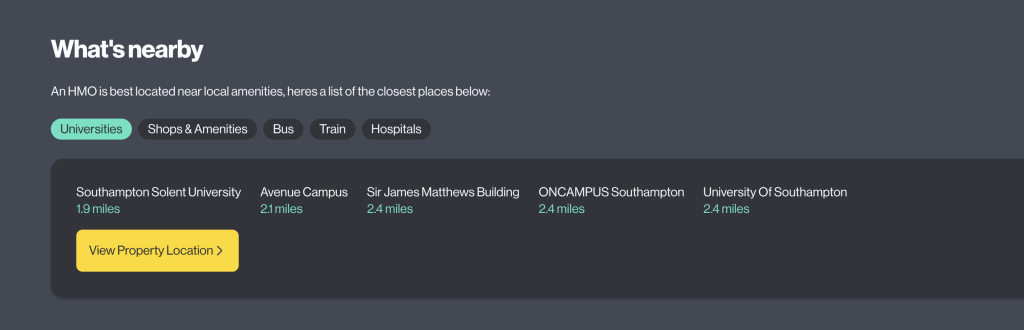
HMO Checker is great for conducting your HMO deal analysis and looking at local demand thanks to its built in tools including:
- A one-of-a-kind demand tool that compares current rooms available in the area vs how many people are looking
- Details on the nearest local amenities like universities, hospitals and shops
- HMO density in the area to assess local competition.
You can give it a go for free when you sign up and get 2 free credits with no credit card required.
2. Understand Planning and Licensing Requirements
Unlike standard buy-to-lets, HMOs are tightly controlled by local councils because they can put extra pressure on neighbourhoods and local services. High concentrations of HMOs may increase parking demand, affect the balance of family housing, and raise issues around waste and noise.
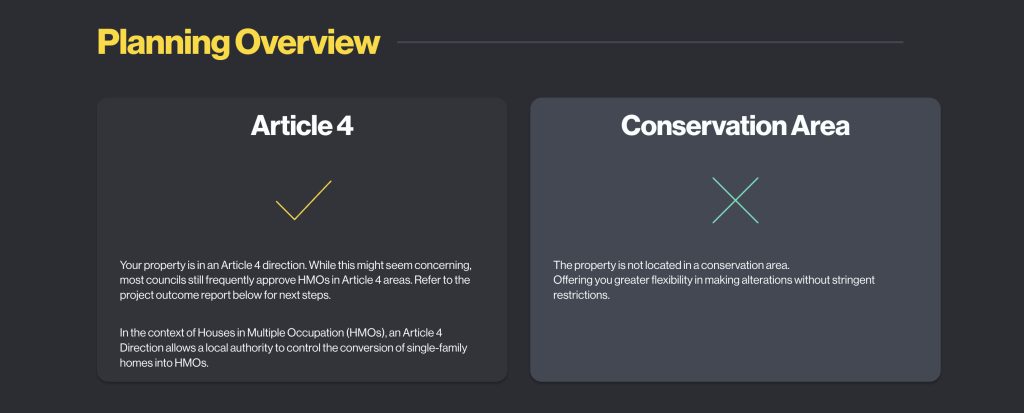
For this reason, many councils require mandatory licensing and restrict new HMOs through Article 4 directions. If you buy without understanding these rules, you could end up with a property you can’t legally let as an HMO.
Key checks include:
- Does the property fall within an Article 4 area (restricting permitted development rights)?
- What type of licence is required (mandatory, additional, or selective)?
- Are there limits on HMO density in the local plan?
HMO Checker helps to take some of the stress out of understanding planning requirements. This is because when you run your desired property through the analysis tool, it can tell you straight away whether your property falls in an Article 4 area, how many planning applications in the area have been approved and what planning you might require. It also shows you HMO density.
With all of this information, it will give you a planning likelihood score, which takes a lot of the hassle out of manually reviewing planning requirements for every property individually.

3. Work out the Financials
With HMOs, the financial analysis is more complex than single lets because income and costs are multiplied. You have more tenants generating rent, but you also have higher running expenses.
New investors often underestimate utility bills, council tax, or the cost of regular maintenance. This can turn what looks like a strong deal into a money-losing one. Running the numbers properly means you know exactly what you’ll earn after all costs – not just the headline rent.
Here are some key figures to calculate:
- Gross rent (monthly rent per room × number of rooms).
- Operating costs (utilities, council tax, insurance, management).
- Mortgage costs.
- Net cash flow and return on investment (ROI).
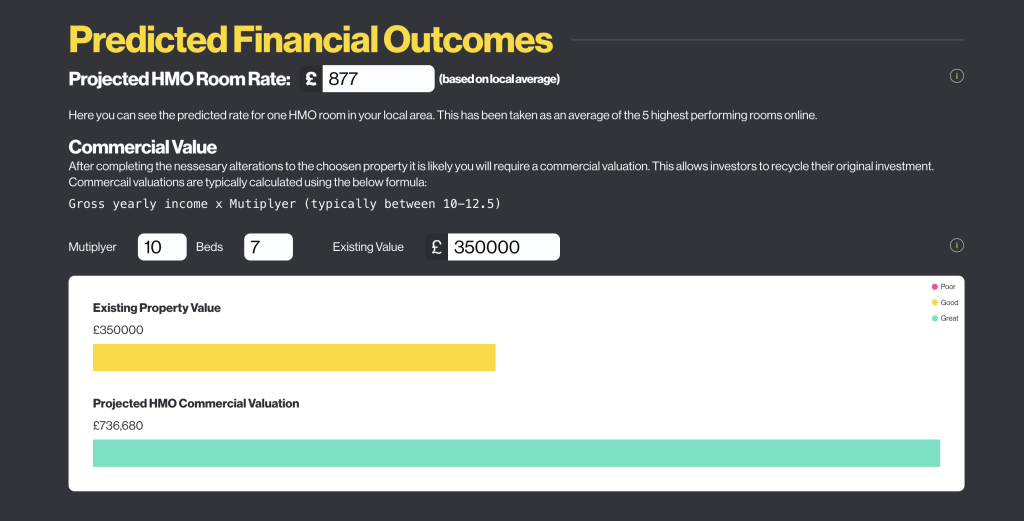
Use our financial analysis tool in HMO Checker, you can see exactly how a property could perform before you invest. By entering the postcode and basic property details, you can instantly view:
- Projected HMO room rate: Know what you could charge per room based on local averages.
- Commercial valuation: Understand the potential value of your property once converted to an HMO.
- Increase in value: Quickly see the percentage uplift from converting to an HMO.
- Property rental income: Compare your current rental income with the projected HMO income to spot opportunities for growth.
- Total HMO Room Rents: See the difference in gross yearly income between 1-8 bedroom HMO’s based on average local area rates

4. Refurbishment and Compliance Costs
Most HMOs require some form of conversion or upgrade because a standard family house rarely meets HMO standards. Councils often require minimum bedroom sizes, sufficient bathrooms for the number of tenants, and strict HMO fire safety measures such as fire doors, smoke alarms, and emergency lighting.
If you ignore these costs, you may find your HMO is either non-compliant or not attractive to tenants. A property that works as a 3-bed family home may need significant investment to function as a safe and desirable 6-bed HMO.
Some of the common compliance and upgrade costs include:
- Fire doors, fire alarms, and emergency lighting.
- Extra bathrooms or en-suites.
- Upgraded kitchens with sufficient cooking facilities.
- EPC improvements to meet minimum energy standards.
Within HMO Checker, you will be able to see the current EPC rating of the property as well as projected HMO occupancy based on the current total floor area, all compliant with national minimum room size requirements.
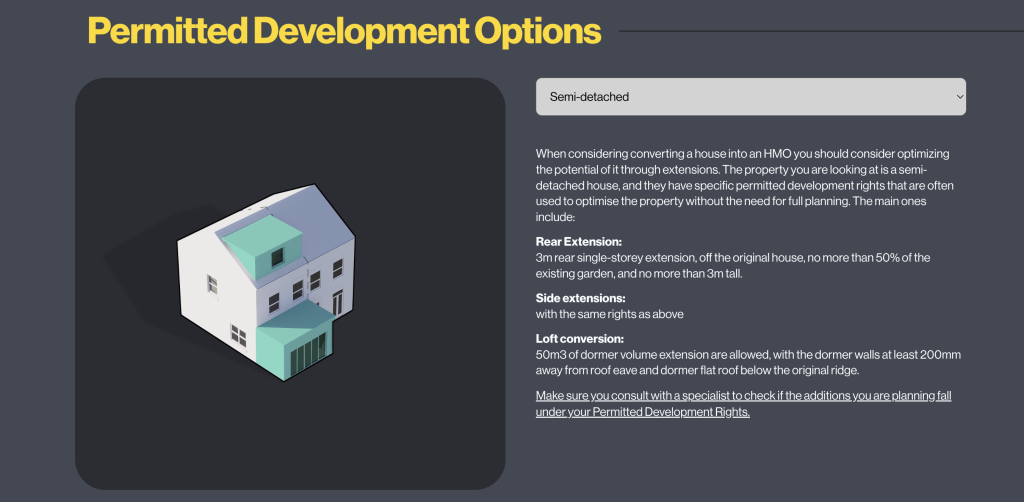
In addition, it will also suggest permitted development options for extending or converting your elected property, including ideas such as rear extensions, side extensions and loft conversions.
5. Management
HMOs are more profitable, but they’re also more management-intensive. The more tenants you have under one roof, the greater the likelihood of disputes, maintenance requests, or admin.
For example, with six tenants you could be dealing with six rent payments, six sets of utility usage, and six potential turnover events per year. That’s very different to a single let with one family.
Here are some core considerations when it comes to management:
- Do you want to self-manage or hire a specialist HMO agent?
- Are you prepared for higher tenant turnover than single lets?
- Can you put robust systems in place for repairs, inspections, and compliance?
6. Evaluate the Risks
HMOs often offer higher returns, but the risks are proportionately higher too. If rents dip by 5-10% or a few rooms remain empty, your profit can quickly disappear because fixed costs (mortgage, bills, compliance checks) don’t go down.
There’s also the risk of changing regulations. Councils can suddenly introduce Article 4 or extend licensing rules, making some HMOs harder to operate.
Risks to plan for include:
- Void periods (allow for at least 5-10%).
- Rising interest rates affecting mortgage affordability.
- Increasing regulation and compliance costs.
- Tenant management challenges.
7. Compare Exit Strategies
The reason exit strategies are so important in HMO investing is that not every property will work forever as an HMO. Markets shift, regulations change, and personal circumstances evolve. If you only plan for one outcome, you may find yourself stuck with a property you can’t refinance or sell.
Exit strategies to consider:
- Refinancing after adding value through a conversion or refurb.
- Selling the property as an HMO to another investor.
- Converting back to a single-let or family home if regulations tighten.
HMO Checker not only shows you potential returns from an HMO property, but also calculates the general uplift in property value once it’s been converted. This means you may have a better idea of potential resell value if you do decide to sell on to another investor.
Final Thoughts
Analysing an HMO deal requires more detail than a traditional buy-to-let, from checking local demand and licensing rules to accurately forecasting costs and planning your exit strategy. But with the right approach (and the right tools), you can confidently spot high-yielding opportunities while avoiding expensive mistakes.
If you want to cut out the guesswork, try our HMO deal analyser at HMO Checker. Simply enter your postcode and instantly see planning restrictions, demand levels, rental yield, EPC rating, and more, everything you need to decide whether an HMO deal stacks up.


