

What is a Student HMO?
Put quite simply, a student HMO is essentially the exact same as a normal HMO. However, the key difference is that it is rented out exclusively to students. It’s a common type of student rental investment property.
Legally, an HMO is a property that is rented out to 3 or more unrelated tenants from different households. HMOs can be as small as 3 occupants but can be as large as 10+ occupants in some areas, particularly those with high shared housing demand – i.e. student areas.
Investing in student accommodation can be a lucrative venture and provide reliable rental income. However, it does come with its own set of unique challenges, so it’s worth ensuring that you understand the pros and cons and weigh up what will make the most sense for you as an investor.
Pros of Student HMO Accommodation Investment
High Rental Yields
HMOs almost always have the potential to achieve higher rental yields when compared to regular BTL properties. In addition, there is research to suggest that student HMOs can achieve some of the highest rental yields of all HMOs. Yields of 8–12% are common, compared to 4–6% for single lets. Research by Paragon Bank also suggests that student letting yields are almost 20% higher than non-student rental letting yields.
Consistent Demand
One of the great benefits of student HMO investment is the constant rental demand that comes with renting to students. As there is an influx of students looking for accommodation every year in major cities in the UK where there are universities, this creates a consistent flow of rental demand which makes student HMOs fairly reliable.
In addition, students will often be looking for affordable accommodation, and tend to look to rent out single rooms rather than entire properties. Therefore, HMOs are an ideal solution for them.

Advance Bookings
Students often rent for periods of 9-12 months and many properties will get booked up well in advance of term start dates so that students are well prepared leading into the term.
This means that their tenancies are both predictable and reliable and you can be more assured of occupancy in advance.
Parental Guarantees
Many students rely on guarantors (usually parents), reducing the risk of unpaid rent. This safety net can ease the worry that renting to students might lead to unpaid rent given that there is a fallback. If your student occupant does not pay their rent, the parents will then be liable to do so.
This sort of guarantee is not in place for HMOs that market to other types of occupants, so it can be an advantage.
No Council Tax
If your HMO is fully occupied by students, no council tax will need to be paid, which can reduce your running costs compared to an HMO which is occupied by young professionals.
Cons of Student HMO Accommodation Investment
Higher Maintenance
With a high turnover of tenants as well as many student lifestyles being notoriously lively and social, it’s fair to assume that managing a student HMO will require a higher level of maintenance and upkeep.
Students may not take care of your property as well as working professionals might do, which means more wear and tear should be expected. Make sure to factor this into your student accommodation investment planning should this be the investment route you go down.
Shorter Tenancy Periods
Given the nature of students coming and going at university, this means that tenancies will be naturally shorter compared to those of young professionals who might be looking for a longer term rental solution.
While it isn’t necessarily always an issue due to continued demand, it does mean that there will be more work to ensure that your student HMO isn’t left vacant after each term. In addition, there is no 100% guarantee that your property will be completely filled every year, so it’s something worth keeping in mind.
Summer Void Period
As many students go home from university during the summer period once the school year comes to an end, there is always going to be a period of time between late spring and September when your HMO may be vacant. This is because the tenancies students look for only last around 9 months starting in September time. Therefore, there will be blocks of time that there may be no one in the property – so no income for that period. This is a crucial factor when considering an HMO as your student rental investment property.

Compliance and Safety Standards for Student HMOs
Compliance with safety standards not only protects tenant safety and wellbeing, but it is also vital to maintain licence conditions and avoid legal liabilities.
Some of the most important areas include:
- Fire Safety: HMOs require working smoke alarms on every floor, fire extinguishers, and clear escape routes.
- Minimum Room Sizes: Bedrooms must meet government size requirements (e.g. 6.51 sqm for a single adult), while kitchens and bathrooms must also be proportionate to the number of tenants.
- Facilities and Maintenance: Common areas such as kitchens, bathrooms and shared living spaces must be safe, well-maintained and properly equipped with suitable amenities for the number of occupants.
It’s worth noting that larger HMOs (7+ tenants), often categorised as Sui Generis HMOs, can carry even more controls, such as acoustic requirements, transport assessments, and detailed management plans.
Pro Tip: Many universities have their own criteria for “approved” student housing. If your property meets these, you may be able to get listed on the university’s official accommodation register. This can drastically improve occupancy rates and save you agency fees, as students often look to university housing lists first.
HMO Licensing for Student Accommodation
Most HMOs in the UK fall under some form of licensing, and this is particularly relevant to student HMOs.
- Mandatory Licensing: Any HMO with five or more tenants (including students) requires a licence.
- Additional and Selective Licensing: Some councils have introduced stricter schemes, meaning even smaller HMOs (fewer than 5 tenants) may require a licence.
Councils also retain the authority to implement Article 4 Directions (covered later in this guide), which can restrict new HMOs in certain areas.
When applying for a licence, landlords should expect property inspections from the local council, with requirements varying between regions. Operating without the correct licence when one is required carries significant financial and legal risks.
Where to Invest in Student HMOs
It goes without saying that student HMOs will only work in towns and cities with one or more universities. Our recent guide on the top 5 cities in the UK for HMO investment does largely cover where there is good demand for HMOs in general, which is largely driven by student demand.
However, in general, our recommendation would be to invest in areas where there are popular universities as well as less HMO restrictions. By this, I mean Article 4 considerations (where you must apply for planning permission to convert a residential property to an HMO).
One of the best ways to know where the best places to invest are is by using HMO Checker. This tool allows you to enter the address of a property you are interested in investing in and then instantly see information on things like Article 4, potential yields, HMO density in the area, previous planning applications and more.
Article 4 Considerations
Article 4 is a planning direction implemented by local councils in areas where there is a high demand for HMOs. It is used for other restrictions as well, such as protecting conservation areas, but in this context is generally used to control the number of HMOs that are being developed in high population areas, particularly where there is a high demand for housing. It means that planning permission is needed to convert what is known as a planning category C3 dwelling house into a C4 HMO for up to 6 people.
With this in mind, it is always worth checking whether article 4 directions are in place before you start considering investing in a certain area. You can use the Article 4 checker within HMO Checker to very quickly find out if a property you are looking at is in an Article 4 area. You can sign up and get 2 credits for free with no credit card required. Alternatively, check your local planning council’s website.
Financial Considerations of Student HMOs
As with any property investment, understanding the numbers is crucial.
- Initial Costs: These may include the property purchase price, conversion expenses to meet HMO standards, and licensing fees.
- Ongoing Costs: Expect higher maintenance, utility bills, and potential property management fees.
- Returns: HMOs typically bring in higher rental income on a per-room basis compared to single lets. For student HMOs, this difference can be even more pronounced.
Pro Tip: Student HMOs often face empty rooms during summer breaks. However, you may be able to mitigate this by renting to short-term tenants, such as international students on language courses. Even better, securing long-term tenancies from first-year students (who may stay for 2–3 years) can drastically reduce turnover and improve profitability.
Tax Benefits of Student HMOs
One unique benefit of renting exclusively to full-time students is council tax exemption. If every occupant in the property is a full-time student, no council tax needs to be paid. To claim this, landlords must provide proof of student status to the local authority.
This exemption helps reduce running costs and can improve overall yields compared to HMOs let to young professionals.
How HMO Checker Helps Find Student Investment Properties
One of the biggest challenges for new and experienced investors alike is identifying whether a property is suitable for conversion into a student HMO. This is where HMO Checker can make the process far easier.
By simply entering a property’s address or postcode, the platform generates a detailed report showing everything you need to know before committing to an investment. This includes:
- Planning & Article 4 – Whether the property sits in an Article 4 area and the likelihood of planning approval.
- Predicted Occupancy – How many HMO rooms you could realistically achieve based on the property’s floor area.
- Financials – Projected monthly room rates, gross rental income, and commercial valuations, allowing you to compare standard buy-to-let yields with HMO potential.
- Compliance & EPC – Energy performance rating and whether upgrades may be needed to meet new efficiency standards.
- Local Market Demand – HMO density, demand levels, and nearby amenities such as universities, transport links, and shops.
- Comparable Planning Data – Other recent HMO applications in the area, helping you gauge council sentiment and avoid saturated markets.
For example, one property report showed how a three-bedroom semi-detached home could be converted into a 7-bed student HMO, achieving an estimated £877 per room per month, with a projected commercial valuation increase of over 70% compared to its existing buy-to-let value.
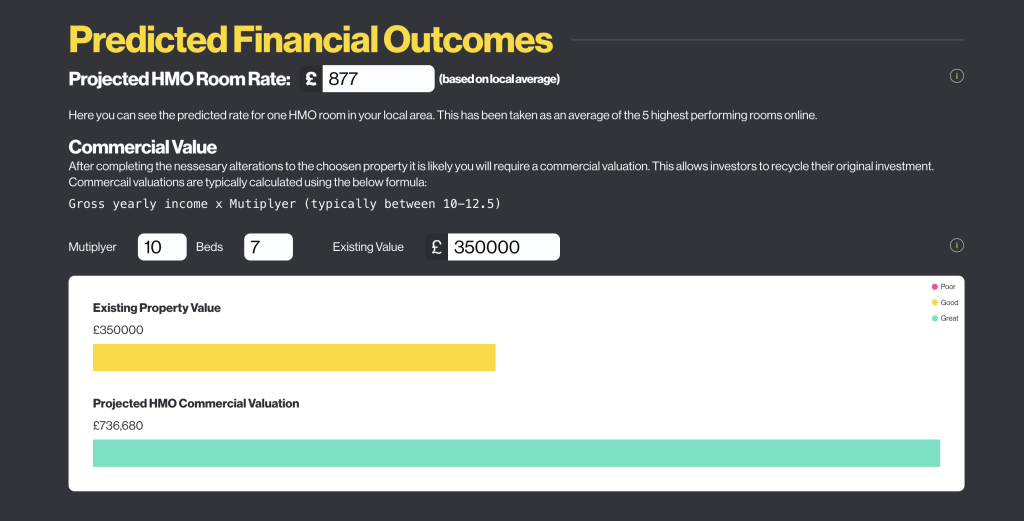
This kind of analysis gives landlords the ability to make data-driven investment decisions and avoid costly mistakes. Instead of guessing whether a property might work as a student HMO, you can instantly see its potential, challenges, and profitability before making an offer.
Pro Tip: Sign up to HMO Checker and you’ll get two free credits with no card required – enough to test out a couple of properties before diving deeper. Take a look >


